The Fastest Growing Cities in Texas: 2026 Report
Our research team compiled and analyzed population growth data to create an updated report on Texas’s fastest-growing cities heading into 2026. Texas continues to lead the nation in population growth, with 7 of the 15 fastest-growing cities in the U.S. for the second consecutive year, according to the U.S. Census Bureau’s Vintage 2025 estimates (released May 2026).
Princeton, TX ranks #1 nationwide with a 30%+ year-over-year population increase, continuing its breakout growth trend from prior years.
Five of the top 15 fastest-growing cities remain concentrated in the Dallas–Fort Worth metroplex, including Celina, Anna, Melissa, and surrounding Collin and Denton County suburbs.
This sustained, multi-year growth cycle is now translating into long-term infrastructure demand, particularly in excavation, underground utilities, roadway expansion, and large-scale site development. Contractors operating in North Texas growth corridors are experiencing consistent backlog across both residential and commercial projects.
Top 15 Fastest Growing Texas Cities by Annual Growth Rate (2024-2025)
| Rank | City | County | Annual Growth Rate | 2025 Population | 2020 Population | Growth Since 2020 |
| 1 | Princeton | Collin | 30.6% | 37,019 | 17,537 | 111.2% |
| 2 | Fulshear | Fort Bend | 26.9% | 54,629 | 17,558 | 211.1% |
| 3 | Celina | Collin/Denton | 18.2% | 51,661 | 17,808 | 190.2% |
| 4 | Anna | Collin | 14.6% | 31,986 | 17,370 | 84.2% |
| 5 | Fate | Rockwall | 11.4% | 27,467 | 18,412 | 49.2% |
| 6 | Melissa | Collin | 10.0% | 26,194 | 14,336 | 82.7% |
| 7 | Hutto | Williamson | 9.4% | 42,661 | 28,081 | 51.9% |
| 8 | Josephine | Collin | 18.5% | 10,351 | 2,255 | 359.0% |
| 9 | Liberty Hill | Williamson | 17.5% | 14,850 | 3,794 | 291.5% |
| 10 | Caddo Mills | Hunt | 17.6% | 5,969 | 1,504 | 296.9% |
| 11 | Royse City | Rockwall | 12.6% | 31,084 | 13,719 | 126.6% |
| 12 | Manor | Travis | 9.1% | 24,273 | 14,112 | 72.0% |
| 13 | Prosper | Collin/Denton | 8.0% | 48,889 | 30,816 | 58.7% |
| 14 | Forney | Kaufman | 9.8% | 43,196 | 23,880 | 80.8% |
| 15 | Georgetown | Williamson | 8.7% | 114,687 | 68,749 | 66.8% |
Fastest Growing Texas Cities by Total Population (2020–2025)
The cities adding the most residents between 2020 and 2025 reflect Texas’s long-term metro expansion rather than short-term migration spikes. Georgetown leads all U.S. cities in absolute population growth with 45,938 new residents, followed closely by Fulshear (+37,071) and Celina (+33,853).
What distinguishes the 2026 outlook is persistence: these same cities have ranked among the fastest-growing for multiple years, signaling structural, not temporary, growth. Master-planned communities, employer relocations, and transportation investments continue to reinforce these trends.
Meanwhile, Austin added 23,425 residents despite slower percentage growth, illustrating how core metros remain powerful population anchors alongside suburban expansion. This combined urban–suburban growth is placing record pressure on site preparation, water and sewer extensions, and utility infrastructure statewide.
Fastest Growing Texas Cities by Total Population Added (2020-2025)
| City | Population Added | Current Population | Growth Rate | Primary Growth Drivers |
| Georgetown | 45,938 | 114,687 | 66.8% | Austin proximity, master-planned communities |
| Fulshear | 37,071 | 54,629 | 211.1% | Houston suburban expansion, new developments |
| Celina | 33,853 | 51,661 | 190.2% | Dallas-Fort Worth growth corridor |
| Forney | 19,316 | 43,196 | 80.8% | Eastern Dallas County development |
| Princeton | 19,482 | 37,019 | 111.2% | Dallas suburban affordability |
| Prosper | 18,073 | 48,889 | 58.7% | Premium Dallas suburb expansion |
| Austin | 23,425 | 989,252 | 2.4% | Tech industry growth, job creation |
| Hutto | 14,580 | 42,661 | 51.9% | Austin metro expansion |
| Anna | 14,616 | 31,986 | 84.2% | Dallas-Fort Worth corridor |
| Melissa | 11,858 | 26,194 | 82.7% | North Dallas development |
Metropolitan Area Analysis
The Dallas–Fort Worth metroplex continues to show the highest concentration of high-growth cities in the United States, with five cities ranking in the national top 15. This pattern reflects broader drivers: corporate relocations, relative housing affordability, and sustained job creation.
By 2026, this clustering has created a compounding advantage for infrastructure contractors. Multiple high-growth municipalities within a tight geographic radius allow firms to optimize crew deployment, equipment utilization, and material logistics, significantly improving operational margins.
Growth by Metropolitan Statistical Area
| Metro Area | Fast-Growing Cities (Top 50 – US) | Combined Population Added | Infrastructure Investment |
|---|---|---|---|
| Dallas-Fort Worth-Arlington | 18 | 189,420 | $8.2B (2024-2025) |
| Houston-The Woodlands-Sugar Land | 8 | 82,150 | $4.1B (2024-2025) |
| Austin-Round Rock-Georgetown | 6 | 67,340 | $3.8B (2024-2025) |
| San Antonio-New Braunfels | 4 | 34,890 | $1.9B (2024-2025) |
| Killeen-Temple | 3 | 18,750 | $950M (2024-2025) |
Home Prices vs. Growth
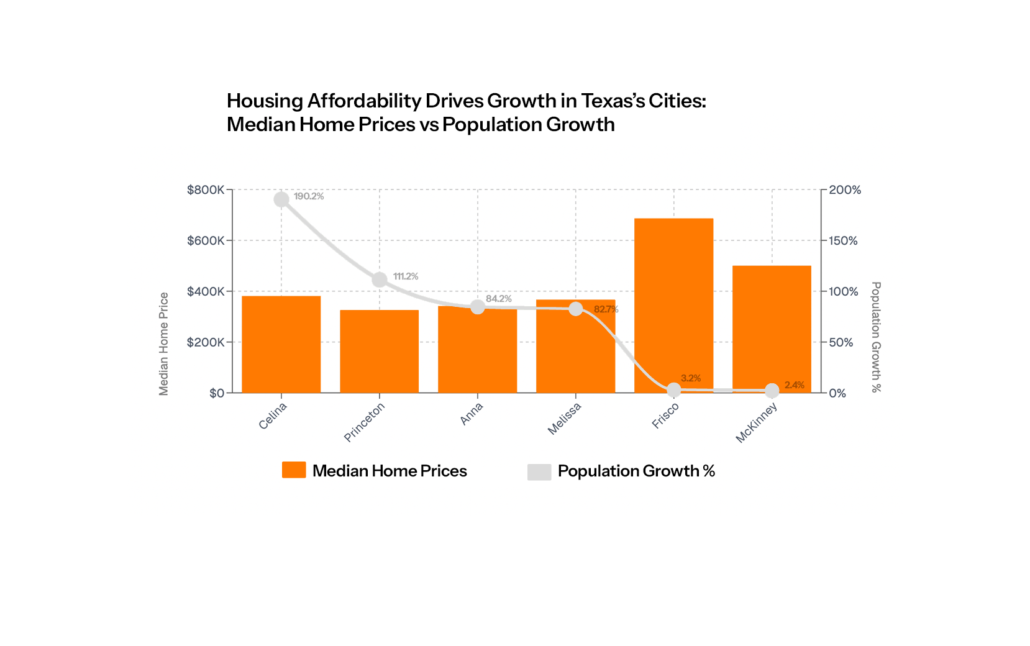
Housing affordability remains a primary growth catalyst. In Princeton, now the fastest-growing city in the U.S. for a second straight year, median home prices average $325,000, compared to $500,000+ in nearby McKinney.
This affordability gap continues to redirect population flows toward outer-ring suburbs, creating predictable, long-term demand for excavation, utility installation, and roadway improvements.
| City | Median Home Price | Population Growth Rate |
| Celina | $380K | +190.2% |
| Princeton | $325K | +111.2% |
| Anna | $340K | +84.2% |
| Melissa | $365K | +82.7% |
| Frisco | $685K | +3.2% |
| McKinney | $500K | +2.4% |
Key Insight: There is a clear inverse relationship between home prices and population growth. Affordable cities like Princeton and Celina continue to absorb the majority of new residents, while high-cost markets experience slower expansion, shaping where infrastructure capital is deployed.
2026 Outlook: Population Growth Projections
To assess how Texas’s fastest-growing cities may perform through 2026, we modeled three population growth scenarios using 2020-2025 compound annual growth rates (CAGR), weighted toward the most recent year of growth and adjusted for expected housing, labor, and interest-rate conditions. These projections are not official forecasts, but scenario-based estimates designed to contextualize infrastructure demand.
Projection Scenarios
- Baseline Scenario: Growth moderates slightly as housing supply and labor markets normalize
- High-Growth Scenario: Residential permitting and job creation remain elevated
- Low-Growth Scenario: Development slows due to financing constraints or infrastructure bottlenecks
| City | 2025 Population | 2025 YoY Growth | 2026 Baseline Growth | Projected 2026 Population Range |
|---|---|---|---|---|
| Princeton | 37,019 | 30.6% | 18–22% | 43,700 – 45,200 |
| Fulshear | 54,629 | 26.9% | 15–18% | 62,800 – 64,500 |
| Celina | 51,661 | 18.2% | 12–15% | 57,900 – 59,400 |
| Anna | 31,986 | 14.6% | 9–12% | 34,900 – 35,800 |
| Melissa | 26,194 | 10.0% | 7–9% | 28,000 – 28,600 |
| Georgetown | 114,687 | 8.7% | 6–8% | 121,500 – 123,800 |
| Hutto | 42,661 | 9.4% | 6–8% | 45,200 – 46,100 |
Conclusion
Texas remains the dominant engine of U.S. population growth heading into 2026, with seven cities ranking among America’s fastest-growing communities for multiple consecutive years. The Dallas–Fort Worth metroplex leads this expansion, creating dense, repeatable opportunities for infrastructure contractors.
For excavation contractors like Kitching & Co., these patterns signal multi-year demand visibility across underground utilities, site preparation, and emergency repair services. Concentrated growth in North Texas enables efficient service coverage, predictable project pipelines, and scalable expansion.
Understanding where growth is accelerating, and why, allows contractors and developers to allocate resources strategically, compete more effectively, and plan long-term in Texas’s most dynamic markets.
If you’d like to request a PDF copy of this report you can reach out here.
Sources
- U.S. Census Bureau – “Population Growth Reported Across Cities and Towns in All U.S. Regions.” (May 15 2025) → https://www.census.gov/newsroom/press-releases/2025/vintage-2024-popest.html Census.gov
- Texas Tribune – “The fastest-growing city in the U.S. is in Texas, and it’s not the one you’re thinking of.” (Joshua Fechter, May 15 2025) → https://www.texastribune.org/2025/05/15/texas-fastest-growing-princeton-fort-worth-population-census/ Texas Tribune
- World Population Review – “Fastest Growing Cities in Texas (2025).” → https://worldpopulationreview.com/us-city-rankings/fastest-growing-cities-in-texas ctdata.org+1
- RealPage Analytics – “Texas is Home to Most of Nation’s Fastest-Growing Cities.” → https://www.realpage.com/analytics/texas-nation-fastest-growing-cities/






Leave a Reply
Want to join the discussion?Feel free to contribute!